HOME EVENTS
EXHIBITION
LINKS
EVENTS
EXHIBITION
LINKS
|
|
HOME
|
|
|
|
 |
THE BRANDBERG The rock art in the Upper Brandberg has been thoroughly documented by archaeologists from the University of Cologne and more than 1 000 sites have been recorded. Excavations in the Brandberg, carried out in the 1980s, brought to light evidence of the age of the rock paintings there. Carrying out an excavation in a large painted cave in the Amis Gorge archaeologists began finding granite flakes bearing evidence of paint. One platelet was found to fit exactly into a painting on the ceiling. In the laboratory carbon-bearing material from the same
level as that flake was dated to The famous "White Lady" painting site is situated in the lower Brandberg and because the paintings are executed in the same style as the paintings in the upper Brandberg one can assume a similar age for the art. This famous site is situated above the banks of the river and is hidden between large boulders. Because of the variety of figures painted, the lavish use of colour and the scene into which the "White Lady" is incorporated, it can be considered to be a ritual or ceremonial site. Other such hidden sites are also known in the upper Brandberg. The abandonment of the Brandberg by the ancient painters is thought to have taken place around 2 000 years ago when small stock, I.e. sheep and goats were introduced into the area. It may have been that the painters themselves acquired these animals and thus gradually changed their lifestyle from hunter-gatherers to herders. Or it may have been that the painters had already left before the herders arrived, perhaps leaving due to a number of years of drought that dried up even the deep cisterns where many litres of water would accumulate in good rain years. On the other hand, herders could have driven the hunter-gatherer population out and taken over. It is known that domesticated animals were introduced into the area about 2 000 years ago and this would coincide with the assumed end of the painting era. There are a few paintings of animals that could be sheep,
goats or cattle, but in most cases identification is not
certain. While the remains of the stone age cultures found
lying on the various ancient floor levels show that the
rock shelters were the homes of the At the foot of the mountain and on many of the large plateaux within the Brandberg there are circles of stones that were once the base of the huts. These stones probably held the posts that supported the main walls.
|
|
|
THE ERONGO MOUNTAINS The rock art in the Erongo Mountains, only 150 km from
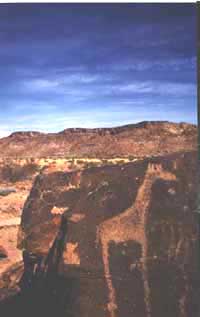
the Brandberg, is very similar in style In the Brandberg there are many giraffe painted in scenes with cloud formations, rain and rainbows, indicating that the giraffe in that area was considered to be a rain animal. In the Erongo Mountains the giraffe can also be found in similar scenes, indicating that there was a shared culture. It could even have been the same group of people migrating back and forth depending on the availability of food and water. It is obvious that at no time were these areas inhabited
by large groups. Some thousands of |
|||
|
Twyfelfontein, Namibia, Africa |
|
||
|
Spitzkuppe The Spitzkuppe stands isolated in the Namib Desert 150 km from the coastal town of Swakopmund. It is a scenically beautiful area and used to have an abundant wildlife population - until some mining companies started working their claims. One such company has for some years been actively extracting the granite in the area known as the Klein Spitzkuppe. The granite cliffs and outcrops have been systematically blown up, cut into blocks and sold for the construction of prestigious buildings. The Spitzkuppe contains many rock shelters and overhangs in the granite cliffs where there have been numerous rock paintings. A survey carried out last year mentions 35 sites found, with hundreds of paintings. Although only eight sites are known by the local African population, they claim that there were many more painting sites before the mining started. There is a very poor record of the rock paintings in the Spitzkuppe. It is one of the areas that has not been thoroughly researched. The rock paintings are different to those in the Erongo
and Brandberg. The figures are smaller, |
|||